Contra o imperialismo, o capitalismo e o neoliberalismo. A favor dos trabalhadores: Socialismo ou Barbárie!

Palestina Livre!


Palestina em imagens: junho de 2025

A Intifada Eletrônica 4 de julho de 2025

Pessoas carregam o corpo de um homem que foi morto enquanto tentava pegar um saco de farinha depois que caminhões de ajuda entraram na área de Zikim, no norte da Cidade de Gaza, em 17 de junho. O homem morto foi posteriormente identificado como Muhammad Yousif al-Zaanin, de 20 anos, de Beit Hanoun, norte de Gaza. Yousef ZaanounActiveStills

As forças israelenses massacraram palestinos em busca de suprimentos de comida e abrigo em tendas em Gaza durante junho, quando um bloqueio contínuo ao combustível deixou as operações humanitárias no território à beira do colapso total até o final do mês.

Todo o combustível recuperado das reservas acessíveis em Gaza foi alocado, disse o Escritório das Nações Unidas para a Coordenação de Assuntos Humanitários em 2 de julho.

“Como resultado, os serviços que salvam vidas, incluindo saúde, água e saneamento, telecomunicações e serviços de proteção, correm risco iminente de fechar”, segundo o OCHA.

Enquanto isso, Israel lançou um ataque não provocado ao Irã em junho, desencadeando um confronto de 12 dias, enquanto colonos atacaram comunidades palestinas na Cisjordânia, onde famílias nos campos de refugiados de Jenin, Tulkarm e Nur Shams foram repetidamente deslocadas desde o início do ano.

Israel continuou a destruir estruturas nesses campos, que “permanecem inacessíveis aos residentes e atores humanitários”, de acordo com o OCHA. “As forças israelenses disparam contra os moradores que estão tentando voltar para suas casas.”

A man stands next to a Star of David spray-painted by Israeli settlers in the West Bank village of Khalet al-Daba, located in Masafer Yatta near the southern West Bank city of Hebron, 1 June. Residents of the community face imminent forced displacement after the Israeli military razed most of the village and continues to allow settlers to attack, occupy and destroy its orchards. Omri Eran VardiActiveStills

As of 2 July, according to the Palestinian health ministry in Gaza, at least 57,012 Palestinians had been killed in the territory since 7 October 2023.

This cumulative figure “includes 223 fatalities who were retroactively added on 2 July 2025 after their identification details were consolidated and approved by a ministerial committee,” the UN Office for the Coordination of Humanitarian Affairs stated.

The health ministry said that during that same period, 640 people had been killed and nearly 4,500 injured while trying to access food supplies since 27 May, the date that the Gaza Humanitarian Foundation began operating distribution points.

As of 2 July, more than “714,000 people, or a third of Gaza’s population, [had] been displaced over the past three months,” according to OCHA.

OCHA added that “at least 107 aid workers have been killed since the start of 2025, including nine in the past week, bringing the total to 479 since October 2023, among them 326 UN staff.”

The aid workers killed in June included Ramzi Khader, an employee of the UN Development Program, who perished in an Israeli airstrike on his home in Jabaliya, northern Gaza, on 6 June, along with 36 members of his family, including his wife and six of their children.

A woman searches for an internet signal in a camp for displaced persons on 2 June. Yousef ZaanounActiveStills

Aid distribution in Gaza “has become a death trap,” Philippe Lazzarini, the head of UNRWA, the UN agency for Palestine refugees, stated on 1 June.

At least 32 Palestinians were killed that day and dozens seriously injured while attempting to access food at distribution points set up by the Gaza Humanitarian Foundation, a militarized American-Israeli scheme that began operations during May.

The foundation is “a hodgepodge of Israeli and US intelligence operatives, sketchy finance firms in the US, mercenaries and private military contractors posing as humanitarians,” the former senior UN official Craig Mokhiber told The Electronic Intifada during June.

He referred to them as representing the “final phase of the genocide.”

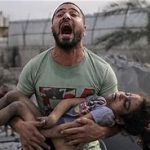
People mourn over the body of a child who was killed in an Israeli strike, Nasser Medical Complex, Khan Younis, southern Gaza Strip, 5 June.  Abdullah Abu Al-KhairAPA images

Benjamin Netanyahu, the Israeli prime minister, has said that the Gaza Humanitarian Foundation scheme has allowed Israel to ease international pressure and prolong its genocidal campaign in Gaza.

“The weaponization of food for civilians” and preventing access to life necessities “constitute a war crime and may constitute elements of other international crimes, including genocide,” the UN human rights office warned at the beginning of June.

In an exposé published by Haaretz newspaper on 27 June, Israeli officers and soldiers admitted that they were ordered to shoot at crowds of people gathered near food distribution points.

One unnamed soldier told the paper that people seeking aid are “treated like a hostile force – no crowd control measures, no tear gas – just live fire with everything imaginable: heavy machine guns, grenade launchers, mortars.”

“Then, once the center opens, the shooting stops, and they know they can approach,” the soldier added. “Our form of communication is gunfire.”

Worshippers pray at the ruins of the Albanian mosque in Khan Younis, southern Gaza Strip, in observance of Eid al-Adha, on 6 June. Doaa AlbazActiveStills

On the second day of June, Israeli forces shot and killed Yousef Fuqahaa, 14, “suddenly and without warning” at an entrance to Sinjil, a village near Ramallah in the West Bank, according to Defense for Children International-Palestine.

The military claimed that the boy threw stones and bottles at soldiers, “an allegation rejected by eyewitnesses,” according to the rights group.

After shooting Yousef, “Israeli forces raided a nearby house that had surveillance cameras and deleted footage of the attack,” DCIP added. Israel is withholding the boy’s body.

Animals are slaughtered on the first day of Eid al-Adha in Gaza City, 7 June. Gaza has a crisis in the availability of livestock due to the Israeli blockade, death of animals in attacks, the destruction of fattening farms, a lack of fodder and a shortage of imported animals. Due to high prices and economic desperation, there is little demand for sacrificial animals and farmers are struggling to sell their livestock. Omar AshtawyAPA images

Two additional Palestinian children were killed by Israeli forces in the West Bank during June.

On 23 June, Ammar Hamayel, 13, was shot in the back by Israeli forces who were “stationed in a concealed position” while walking with a friend near a settlement bypass road next to Kafr Malik, a village near Ramallah, according to DCIP.

Israeli forces assaulted family members and neighbors who attempted to reach the boy and provide aid, and prevented an ambulance crew from assisting the boy, who the rights group said was an outstanding student and winner of local and international Muay Thai competition titles.

“Israeli forces handed over Ammar to a Palestinian ambulance which brought him to the Palestine Medical Complex in Ramallah, where he was pronounced dead,” DCIP added.

On 26 June, an Israeli sniper positioned on the roof of a Palestinian home killed Rayan Houshyeh, 13, during an incursion in al-Yamoun village near Jenin.

According to DCIP, Rayan looked over a wall in an alley “to observe nearby Israeli forces when the sniper opened fire … striking him in the neck, abdomen and thigh.” The sniper fired towards young men who attempted to reach the boy, who was pronounced dead upon arrival to hospital.

Rayan was the 30th Palestinian child killed by Israeli forces in the West Bank during 2025.

Israeli troops observe as Palestinians walk with supplies that they received from the Gaza Humanitarian Foundation in al-Bureij, central Gaza, 8 June. Moiz SalhiAPA images

On 2 June, UN human rights experts demanded the safe passage of passengers aboard the Madleen, a Freedom Flotilla Coalition ship bound for Gaza.

“The people of Gaza have the right to receive aid through their own territorial waters even under occupation,” the experts said, “and the Coalition ship has the right to free passage in international waters to reach the people of Gaza.”

The ship was seized by Israeli forces a week later, on 9 June, and its 12 passengers, who included the prominent climate activist Greta Thunberg and two journalists, were detained in Israel and deported over the next several days.

Agnès Callamard, the head of Amnesty International, said that during its voyage, the Madleen “emerged as a powerful symbol of solidarity with besieged, starved and suffering Palestinians amid persistent international inaction.”

Meanwhile, Egypt detained hundreds of activists who traveled to the country in an attempt to reach Rafah and break the blockade on the Gaza Strip.

An Israeli soldier walks by a body during a raid of the Old City of Nablus in the northern West Bank, 10 June. Two brothers were killed and dozens were injured during the raid. Wahaj Bani MouflehActiveStills

On 3 June, the Red Cross said that it “received a mass casualty influx” of patients injured while trying to reach an aid distribution site at its field hospital in Rafah, southern Gaza, earlier that day. Of those cases, 19 were declared dead upon arrival and eight more died shortly thereafter.

It was “the highest number of weapon-wounded patients received in a single incident since the establishment of the field hospital” more than a year ago, the Red Cross added.

At least 27 people were killed and 90 injured when Israeli forces opened fire on a crowd of thousands gathered at dawn near an aid site in Rafah that day, according to Euro-Med Monitor.

The Geneva-based group said within the past week that the Israeli military had killed and injured more than 600 Palestinians near aid distribution centers in areas under its control.

Usama Assaf, 4 years old, receives medical care at his grandmother’s home in Gaza City after losing his entire family in an Israeli airstrike that claimed the lives of his parents and siblings, 10 June. Usama fractured both his legs and his pelvis in the attack. Omar AshtawyAPA images

On 5 June, the World Health Organization warned that Gaza’s health system “is collapsing” with Nasser Medical Complex and Al-Amal Hospital at risk of becoming non-functional due to Israeli military encroachment, attacks and forcible evacuation orders.

The facilities are the last two functioning public hospitals in the Khan Younis area, where most of the Strip’s population is now concentrated. “There are already no hospitals functioning in the north of Gaza,” WHO said.

The following day, on 5 June, the Israeli military fired inside the compound of Al-Ahli Arab Hospital in Gaza City, killing four journalists.

Thirty people, including four hospital staff, were wounded in the “unprovoked assault against civilians,” according to the Episcopal Diocese of Jerusalem, which administers Al-Ahli Arab Hospital.

“This is at least the third instance of journalists apparently targeted and killed at hospitals,” according to the UN human rights office, which cited an attack on Nasser Medical Complex in April and an attack at Al-Awda Hospital in December.

A photo taken on 15 June shows buildings damaged by a missile fired from Iran in Bat Yam, central Israel. Chen JunqingXinhua via ZUMA Press

The UN human rights office said it had verified the killing of 227 Palestinian journalists in Gaza since October 2023.

The “apparent targeting of Palestinian journalists in Gaza, combined with the denial by Israel of access to foreign journalists” appears to be a deliberate policy to “limit the flow of information … and prevent reporting on the impact of [Israel’s] attacks and denial of humanitarian assistance.”

More than 100 press freedom advocacy groups and international news rooms demanded that foreign journalists be granted immediate and unrestricted access to Gaza and the full protection of Palestinian journalists.

Tents serve as temporary shelters for displaced Palestinians in the al-Maqousi area in the northern Gaza Strip, 15 June. Omar AshtawyAPA images

On 10 June, the World Food Program said that it dispatched 59 trucks carrying 930 metric tons of wheat flour destined for northern Gaza but which was “stopped along the way and offloaded by hungry civilians in critical need of food to feed their families.”

The UN food relief agency said that it has only been able to “bring in small amounts of life-saving food and aid” into Gaza since Israel resumed limited humanitarian assistance on 19 May.

“This is largely due to delays or denials of permission for humanitarian movements due to expanded military operations,” the agency added.

Telecommunications were severed in Gaza City and northern Gaza on 10 June. The entire territory experienced telecommunications failure on 12 June after military activity damaged infrastructure.

Connectivity was partially restored on 14 June but three days later, southern and central Gaza experienced a renewed blackout after a fiber was cut along al-Rashid Street.

“This marks the third major disruption within a week – highlighting the extreme fragility of Gaza’s telecommunications infrastructure and the urgent need for sustained safe access for repairs,” according to the Emergency Telecommunications Cluster, a global network of groups providing communications services in humanitarian emergencies.

The cluster added that “severely reduced data speeds and degraded mobile networks continue to undermine humanitarian coordination and prevent civilians from accessing life-saving information and assistance.”

Meanwhile, “telecom providers are facing critical shortages of fuel and engine oil, with limited reserves expected to be completely depleted within days,” the cluster said on 17 June.

“Without immediate resupply, generators powering the infrastructure are on the verge of failure, imminently threatening a total collapse of all communication services,” the cluster added.

Thousands of people walk along al-Rashid Street carrying bags of flour after aid trucks entered through the Zikim area in northern Gaza City, 17 June. Several of those seeking aid were shot by Israeli forces. On the same day, dozens of people were killed and hundreds more were injured at the aid distribution location in Rafah, southern Gaza. Yousef ZaanounActiveStills

On 12 June, the Red Cross said that in the previous two weeks, its field hospital in Rafah “has had to activate its mass casualty incident procedure 12 times, receiving high numbers of patients with gunshot and shrapnel wounds.”

It had received 933 cases during that period, including 41 patients declared dead upon arrival. A majority of the patients were trying to reach aid distribution sites when they were injured.

“Medical personnel are struggling to cope with the overwhelming number of patients,” the Red Cross said. “They are working to save patients under constant exposure to stray bullets, endangering the safety of those providing and receiving medical care.”

“Supplies are being used faster than they can be replenished,” the Red Cross added.

An Israeli army sniper is seen through a window during a raid on Balata refugee camp in the northern West Bank, 18 June. The operation involved the storming of homes, arrests and the demolition of a metal workshop. Wahaj Bani MouflehActiveStills

On 13 June, the UN Security Council failed to adopt a resolution introduced by Slovenia demanding a permanent ceasefire in Gaza, with 14 member states voting in favor and one member – the United States – voting against, with no abstentions.

Israel’s representative to the UN thanked the US and warned the General Assembly against wasting “more of your time” by holding an emergency meeting triggered by the veto of the resolution. He said that no UN resolution “will stand in our way.”

That same day, on 13 June, Israel launched a surprise and unprovoked attack on Iran, targeting the country’s military leadership and senior scientists.

Iran hit major population centers in Israel in response, destroying entire neighborhoods and exhausting the country’s supply of missile interceptors.

The extent of Iran’s blows to Israeli military targets is not fully known due to military censorship in that country.

The conflagration begun by Israel ended after 12 days following American strikes on three nuclear sites in Iran and a reprisal Iranian strike on a US military base in Qatar.

More than 600 people were killed in Iran while 28 people were killed in Iranian strikes in Israel, including three women and a girl who died when a missile hit a building in Tamra, a Palestinian city near Haifa lacking bomb shelters.

Israelis stand in front of a building damaged by an Iranian missile fired on Ramat Gan near Tel Aviv, 19 June. lia YefimovichDPA via ZUMA Press

The UN monitoring group OCHA said that since 13 June, following the start of Israel’s offensive in Iran, it had documented “36 incidents whereby Israeli soldiers took over roughly 267 Palestinian homes [in the West Bank] … for periods ranging from several hours to a few days.”

“This has affected at least 1,300 people who in most cases returned to their homes to find their property vandalized,” according to OCHA.

“These include 237 housing units whose residents were temporarily evacuated in the six governorates in the northern West Bank,” OCHA added. Meanwhile, Israel closed most of its checkpoints in and around the West Bank and added new closures after the start of its attack on Iran, resulting in heavy traffic congestion.

Nearly 900 people in Gaza were killed during Israel’s offensive in Iran.

Israeli forces stand next to a plaque honoring Ahmad Abu Arrah, a commander in the armed wing of Hamas who was killed last year, during a raid in the northern West Bank city of Aqaba, 20 June. Wahaj Bani MouflehActiveStills

On 14 June, the Red Cross raised alarm over Israeli evacuation orders around Nasser Medical Complex in Khan Younis in southern Gaza.

There will be no place for patients to receive specialized care if the hospital is forced to shut down, the humanitarian group warned.

In addition to specialized care, Nasser Medical Complex “provides blood bank services” that allow for blood transfusions at the Red Cross Field Hospital in Rafah and “forensic services and management of the dead,” the Red Cross said.

A woman tries to collect food at a community kitchen in Khan Younis as Israel continues to throttle the entry of humanitarian aid, 21 June. Doaa AlbazActiveStills

At least 70 people were killed and 200 injured when the Israeli military fired tank shells at a crowd of Palestinians waiting for UN food trucks in Khan Younis, southern Gaza, on 17 June.

It was the deadliest incident at an aid site after such mass casualty events near distribution points became an almost daily occurrence when an American-Israeli militarized aid scheme began operating in Gaza on 27 May.

Euro-Med Monitor, a human rights group based in Geneva, said that its field team in Gaza had documented the involvement of a local armed gang collaborating with the Israeli military in deadly attacks on people attempting to reach aid points.

The group said it also “received credible information that a foreign mercenary employed by the US security company overseeing the aid distribution center shot and killed a civilian” near Rafah, in southern Gaza, on 9 June.

Pessoas inspecionam os danos após ataques israelenses noturnos em casas e tendas improvisadas em al-Mawasi, uma área de Khan Younis, sul da Faixa de Gaza, em 23 de junho. Imagens de Moaz Abu TahaAPA

Algumas semanas depois, a Associated Press informou que havia obtido vídeos e relatos confirmando que “empreiteiros americanos que guardam locais de distribuição de ajuda em Gaza estão usando munição real e granadas de efeito moral enquanto palestinos famintos lutam por comida”, mesmo quando não havia “ameaça”.

Dois empreiteiros que trabalham para a Fundação Humanitária de Gaza disseram que Israel está coletando dados biométricos e outros dados por meio de câmeras instaladas nos locais de distribuição.

Israel também está facilitando o saque de ajuda humanitária, alimentando a fome e o caos em Gaza, disse o grupo palestino de direitos humanos Al Mezan em um relatório publicado em 14 de junho.

A escalada de saques ao longo de maio e início de junho aponta para “uma política israelense sistemática que transforma a fome, a privação e o caos em armas para promover sua campanha genocida”, de acordo com Al Mezan.

Equipes de resgate israelenses operam no local de um ataque com mísseis em uma área residencial em Beersheba, sul de Israel, em 24 de junho. O serviço médico nacional de emergência relatou pelo menos quatro pessoas mortas e dezenas de feridas no sul de Israel. Saeed QaqZUMA Fio de Imprensa

Em 18 de junho, a agência de saúde sexual e reprodutiva da ONU, UNFPA, alertou que quase 11.000 mulheres grávidas em Gaza estão em risco de fome e cerca de “17.000 mulheres grávidas e lactantes precisarão de tratamento urgente para desnutrição aguda nos próximos meses”.

Estima-se que “uma em cada três gestações agora é considerada de alto risco e um em cada cinco recém-nascidos nasce prematuro ou abaixo do peso, exigindo cuidados especializados que estão cada vez mais indisponíveis”, acrescentou a agência.

Mais de 190 caminhões carregados com suprimentos urgentemente necessários – incluindo maternidades móveis, ultrassons e incubadoras portáteis para bebês prematuros – foram impedidos de entrar em Gaza, de acordo com o UNFPA.

Também em 18 de junho, o escritório de direitos humanos da ONU pediu aos militares israelenses “que cessem imediatamente o uso de força letal em torno de pontos de distribuição de alimentos em Gaza, após repetidos casos de tiroteio e assassinato de palestinos que tentavam ter acesso a alimentos lá”.

Pessoas com ferimentos graves não têm acesso a tratamento médico devido à “destruição quase completa do sistema de saúde em Gaza”, acrescentou o escritório de direitos humanos da ONU.

“Eles enfrentam uma dor excruciante e morte potencial”, acrescentou o escritório.

A ordem civil em Gaza deteriorou-se severamente devido aos ataques de Israel, ao bloqueio total e ao ataque à força policial civil.

“Como resultado, os palestinos estão cada vez mais enfrentando a escolha desumana de morrer de fome ou correr o risco de serem mortos enquanto tentam acessar a pouca comida disponível”, disse o escritório de direitos humanos da ONU.

Sarah Qannan, 17, from Khan Younis continues her studies inside a tent her family set up over the ruins of their home, 24 June. Sarah is trying to review her lessons in preparation for the tawjihi matriculation exams after she and other students in Gaza were deprived of education for the second consecutive year. Abdallah AlattarAPA images

On 20 June, the UN human rights office condemned the killing and possible summary executions “of Palestinian staff associated with the so-called Gaza Humanitarian Foundation by armed men allegedly affiliated with Hamas.”

The human rights office said it had received information that armed men attacked a bus carrying local contractors on 11 June.

“The armed men stripped and beat the workers and shot some of them,” the UN office added. The workers were allegedly tortured and 12 were reportedly killed.

Malnutrition among children in Gaza “is rising at an alarming rate,” the UN children’s fund UNICEF stated on 19 June. The agency said that “5,119 children between 6 months and 5 years of age [were] admitted for treatment for acute malnutrition in May alone.”

Nearly 640 of these children have severe acute malnutrition, “the most lethal form of malnutrition,” UNICEF added.

Cases of acute malnutrition are likely to rise to the highest level since October 2023 unless Israel allows “the large-scale delivery of life-saving aid through all border crossings,” according to UNICEF regional director Edouard Beigbeder.

Huda Abu al-Naja, 12, shows an archive photo of herself while she is treated at Nasser Medical Complex in Khan Younis, southern Gaza, 25 June. Huda, who has been displaced to al-Mawasi, suffers from severe malnutrition and a serious wheat allergy, which have worsened due to the ongoing humanitarian crisis. Doaa AlbazActiveStills

Defense for Children International-Palestine published a report on 24 June “asserting [that] Israeli authorities have deliberately weaponized starvation as a method of genocide.”

This policy has resulted in “the preventable deaths and suffering of Palestinian children in Gaza that will carry negative impacts for generations to come.”

“Doctors Against Genocide contributed a comprehensive section on the devastating medical, developmental and psychological consequences of starvation in children,” DCIP said.

“They warn of long-term and often irreversible effects, including stunted growth, neurological damage, weakened immune systems and permanent cognitive impairment.”

Most families in Gaza were surviving on “just one notoriously poor meal per day” in Gaza, according to OCHA, “while adults routinely skip meals to prioritize children, the elderly, and the ill amid deepening hunger and desperation.”

Um caminhão transportando ajuda viaja pela área de Sudaniya, a noroeste da Cidade de Gaza, sob a proteção de guardas particulares, em 25 de junho. Foi a primeira vez em meses que organizações internacionais conseguiram enviar ajuda para pontos de distribuição na Cidade de Gaza. Yousef ZaanounActiveStills

A data de 20 de junho marcou o 100º dia de um bloqueio à entrada de combustível em Gaza, que permanecia em vigor no momento da publicação desta história na Intifada Eletrônica.

No mesmo dia, James Elder, porta-voz do UNICEF, alertou que, sem combustível, as usinas de dessalinização que permanecem em operação em Gaza com capacidade reduzida “cessarão completamente”.

“Sem combustível, o transporte de milhões de litros de água para as pessoas vai parar”, acrescentou. “Nos principais pontos de produção, um grande número de burros está começando a substituir os caminhões.”

Observando que uma carroça de burro “mal pode carregar 500 litros”, em comparação com a capacidade de transportar 15.000 em um caminhão, Elder disse que “até os burros estão diminuindo a velocidade – mal há comida suficiente para mantê-los em movimento”.

Um menino procura itens utilizáveis nos escombros de prédios fortemente danificados e desmoronados após ataques israelenses ao campo de refugiados de Beach na Cidade de Gaza, em 26 de junho. Omar AshtawyAPA imagens

Em 19 de junho, o Conselho Norueguês de Refugiados disse que três meses depois que Israel quebrou a trégua em 18 de março, “o sistema de abrigos em Gaza está à beira do fracasso”.

Mais de 680.000 pessoas em Gaza foram deslocadas desde meados de março, já que mais de 82% do território de Gaza está sob ordens de deslocamento ou zonas proibidas declaradas pelos militares israelenses.

O Conselho Norueguês de Refugiados acrescentou que “o deslocamento implacável, as restrições de acesso e a destruição quase total de moradias deixaram centenas de milhares de pessoas sem abrigo adequado e atores humanitários sem meios para ajudá-los”.

O Centro Palestino de Direitos Humanos divulgou um relatório em junho descobrindo que mulheres e meninas são desproporcionalmente afetadas pela falta de necessidades básicas, incluindo água potável e instalações sanitárias, bem como uma aguda falta de privacidade e maior risco de violência de gênero.

Mulheres e meninas recorreram a mecanismos extremos de enfrentamento, incluindo limitar a frequência dos banhos, evitar beber água para reduzir a necessidade de usar banheiros ou usar baldes em barracas para se aliviar, bem como usar contraceptivos orais continuamente para suprimir seus ciclos menstruais.

Palestinians distribute humanitarian aid delivered by international organizations in Gaza City on 26 June. For the first time in months, international organizations were able to distribute some aid to displaced families in Gaza City. The groups worked with dignitaries and influential families to secure the trucks to prevent them from being looted before they reached their destination. Yousef ZaanounActiveStills

On 21 June, 49,000 high school students began their school leaving exams, known as tawjihi, in the West Bank and overseas, according to the Palestinian education ministry. Students in Gaza remain unable to sit for their exams for the second consecutive year, affecting more than 76,000 pupils.

The education ministry stated on 23 June that special arrangements would be made for high school students in Gaza to sit for their exams as soon as possible.

However, according to OCHA, “implementation of these plans remains contingent on a ceasefire, the lifting of restrictions on the entry of supplies, including tablets needed for the exams, and the reopening of border crossings.”

Meanwhile, OCHA warned in June that “the right to education of nearly 13,000 students, including more than 6,500 girls, is at threat should the Israeli authorities execute pending demolition orders against 84 schools across the West Bank, including East Jerusalem.”

A funeral is held for three Palestinians who were killed by Israeli forces overnight in the West Bank village of Kafr Malik, 26 June. The three were slain after more than 100 Israeli settlers stormed the village, damaging homes and torching vehicles. A 14-year-old boy from the same village, Ammar Hamayel, was killed two days prior. Avishay MoharActiveStills

Israeli settlers attacked Kafr Malik, a Palestinian town near Ramallah in the occupied West Bank, on 25 June, leaving three Palestinians dead at the hands of the Israeli military.

According to OCHA, one of those killed “was a 34-year-old Palestinian father of two who, according to community sources, was shot in the head at point-blank range at the entrance to his home” while evacuating his wife and children.

The violent rampage by settlers, who set fire to homes and vehicles, was condemned by Germany, the UK and the European Union.

New construction is seen in the Jewish settlement of Tzofim, east of the West Bank city of Qalqiliya, 27 June. Mohammed NasserAPA images

Also on 25 June, settlers attacked the Bedouin community of Dar Fazaa near Ramallah, causing property damage and smoke inhalation injuries. They also attacked farmers working their land on the outskirts of al-Mazraa al-Sharqiya near Ramallah and obstructed emergency responders from putting out a fire in Asira al-Qibliya near Nablus.

OCHA said that it documented some 740 settler attacks against Palestinians leading to casualties or property damage during the first half of 2025, affecting more than 200 West Bank communities.

“This is a daily average of four incidents, similar to the frequency observed in 2024, the highest year on record of settler incidents that resulted in casualties or property damage,” OCHA added.

Fatima al-Nawajaa está com seus filhos dentro de sua casa queimada depois que ela foi atacada por colonos israelenses em Susiya, uma vila ao sul de Hebron, na Cisjordânia, em 27 de junho. O ataque começou às 2 da manhã de 25 de junho, enquanto a família dormia. Devido à falta de água, eles não conseguiram extinguir o fogo, e a casa continuou a queimar até que todo o seu conteúdo fosse destruído. Mosab ShawerActiveStills

Em 24 de junho, o escritório de direitos humanos da ONU e o Conselho Norueguês de Refugiados alertaram que 1.200 palestinos, incluindo crianças, na área de Masafer Yatta, em Hebron, na Cisjordânia, “correm risco crítico de transferência forçada”.

No início do mês, os militares israelenses anunciaram que retomariam o treinamento militar em uma zona de tiro que abrange 13 comunidades e a Administração Civil Israelense – um órgão militar – havia recentemente habilitado a “rejeição retroativa de pedidos de construção palestinos”.

O escritório de direitos humanos da ONU e o grupo norueguês disseram que “as estruturas afetadas incluem casas, escolas, clínicas, sistemas de água e locais religiosos, e as demolições resultarão no deslocamento forçado de 200 famílias, o que pode equivaler a uma transferência forçada”.

A transferência forçada e a deportação constituem “uma grave violação da Quarta Convenção de Genebra e … um crime de guerra”, acrescentaram o escritório de direitos humanos e o grupo norueguês.

“Também pode equivaler a um crime contra a humanidade quando cometido como parte de um ataque generalizado ou sistemático dirigido contra qualquer população civil, com conhecimento do ataque”, acrescentaram.

Israeli forces point their weapons at Palestinian residents and photographers during Israeli settlers’ weekly tour of the Old City of Hebron in the West Bank, 26 June. The Israeli army obstructed the movement of Palestinians trying to reach their homes and created fear and terror throughout the city. Mosab ShawerActiveStills

Also on 24 June, Zahiya Joudeh, 66, was shot in the head and killed while on the roof of her home in Shuafat refugee camp in East Jerusalem. Her family accused the Israeli Border Police of shooting the grandmother while they were operating in the camp.

Israel’s police claimed it was investigating the incident.

Earlier in the month, soldiers shot and killed a Palestinian man during a raid in al-Walaja village near Bethlehem.

“According to eyewitnesses, Israeli soldiers entered an under-construction apartment, handcuffed and blindfolded three Palestinians who were present, and then shots of live ammunition were heard,” according to OCHA. Israel is withholding the man’s body.

In addition to the aforementioned cases, Palestinian fatalities in the West Bank in June include a man who was shot while attempting to enter Israel through an opening in Israel’s annexation wall south of Hebron on 7 June; the killing of a man by undercover forces during a raid in Tammun near Tubas on 10 June; the killing of two brothers during a 30-hour operation in Nablus on 10 June; and the shooting death of a man after he allegedly opened fire at soldiers at Harmesh checkpoint near Jenin on 12 June.

Residents of eastern Gaza evacuate to Gaza City after receiving orders from the Israeli military, 29 June. Omar AshtawyAPA images

Seven Israeli soldiers were killed by a fighter with the Qassam Brigades, the armed wing of Hamas, in a close-range ambush on a military vehicle in Khan Younis on 24 June.

Video of the stunning ambush released by the Qassam Brigades on Wednesday shows a fighter carrying a rifle running towards the armored personnel carrier, upon which he climbs and drops a shawaz explosive device directly into the cabin. The recording shows the fighter safely withdrawing before the military vehicle becomes engulfed in flames.

Moshe Gafni, a leading figure in the ultra-Orthodox party United Torah Judaism, said “I don’t understand what we’re fighting for and for what purpose” after the deaths of the seven soldiers.

Around a week later, the Israeli military and the Shin Bet spy agency claimed to have killed two Hamas fighters who it said were involved in the ambush in a drone strike.

Em 25 de junho, 12 caminhões “transportando suprimentos médicos essenciais, incluindo unidades de sangue” foram apoiados pela Organização Mundial da Saúde para distribuição em “pontos prioritários de serviços de saúde em Gaza”. Foi a primeira missão desse tipo desde 2 de março e “representa apenas uma fração do que é necessário para atender às enormes necessidades de saúde no terreno”, de acordo com o OCHA.

Ayat al-Sardi vive com sua família em um abrigo temporário no bairro de al-Sabra, na Cidade de Gaza, onde cuida de seu filho recém-nascido sobrevivente, Mazen, depois de perder seu irmão gêmeo Ahmad devido à desnutrição grave e à falta de fórmula infantil, em 29 de junho. Os gêmeos nasceram depois de muitos anos tentando engravidar, tornando a perda um choque insuportável. Omar AshtawyAPA imagens

Em 27 de junho, o Programa Mundial de Alimentos publicou uma análise de segurança alimentar descobrindo que os mercados em Khan Younis estavam ficando sem a maioria dos itens alimentares essenciais e que os preços do que permanece disponível “continuam a aumentar a um ritmo alarmante”.

Enquanto isso, a taxa para receber remessas estrangeiras ou para pagamento com cartão de crédito “subiu para um recorde histórico de 40%, criando um fardo extra para a população já financeiramente exausta na Faixa de Gaza”.

A diversidade alimentar em Gaza caiu para seu nível mais baixo desde outubro de 2023, com pessoas consumindo alimentos “severamente deficientes em nutrientes”.

Uma pessoa ferida é evacuada do al-Baqa Cafe, no oeste da Cidade de Gaza, depois de ter sido alvo de um ataque aéreo israelense no oeste da Cidade de Gaza, em 30 de junho. De acordo com o The Guardian, os militares israelenses usaram uma bomba de 500 libras fabricada nos EUA quando atacaram o café lotado à beira-mar, matando pelo menos 24 pessoas, incluindo um cineasta, um artista e uma criança de 4 anos. Omar AshtawyAPA imagens

De acordo com a análise do Programa Mundial de Alimentos, o preço da farinha de trigo aumentou 3.000% em comparação com o custo antes de outubro de 2023, enquanto o preço do açúcar aumentou 6.310%. O custo de um quilo de batatas agora é de 100 shekels ou cerca de US $ 30 na Cidade de Gaza e Deir al-Balah.

O relatório observou que 29 caminhões comerciais foram autorizados a entrar em Gaza transportando itens não essenciais, incluindo “macarrão, chocolate e cigarros”. Os relatórios indicaram que “esses caminhões só foram autorizados a entrar depois que alguns comerciantes em Gaza fizeram um acordo com o exército israelense para liberar parte do dinheiro acumulado dentro de Gaza”.

“As Câmaras de Comércio, Indústria e Agricultura da Faixa de Gaza emitiram uma declaração condenando veementemente esses comerciantes e dizendo que suas ações contribuirão para mais picos nos preços já muito altos nos mercados”, acrescentou o Programa Mundial de Alimentos.

Pessoas inspecionam os danos após ataques israelenses à Escola al-Falah, localizada no bairro de al-Zaytoun, na Cidade de Gaza, em 30 de junho. Salas de aula e áreas da escola usadas como abrigos para famílias deslocadas ficaram inutilizáveis e inabitáveis no ataque. Omar AshtawyAPA imagens

Em 28 de junho, o escritório de direitos humanos da ONU disse que Israel continuava a atacar tendas que abrigavam pessoas deslocadas em al-Mawasi, “matando famílias inteiras, ao mesmo tempo em que ordenava que palestinos de outras partes de Gaza se mudassem para ‘abrigos conhecidos'”, referindo-se a al-Mawasi, apesar da falta de segurança e infraestrutura básica.

Al-Mawasi está “quase completamente ausente … abrigo, sistemas de água e esgoto, remoção de resíduos sólidos, latrinas e instalações médicas.”

As agências humanitárias “pediram repetidamente que Israel facilite o acesso e a entrada de suprimentos para Gaza que são urgentemente necessários para a construção de abrigos”, acrescentou o escritório da ONU.

O escritório de direitos humanos da ONU acrescentou que “os militares israelenses não forneceram publicamente justificativa para nenhum dos 112 ataques a tendas registrados por nosso escritório” e “não conseguiram identificar nenhum objetivo militar legítimo nas proximidades onde esses ataques ocorreram”.

O Euro-Med Monitor afirmou em 29 de junho que “as forças israelenses intensificaram ataques diretos e deliberados contra civis palestinos, visando cada vez mais abrigos e tendas”.

“Esses ataques refletem uma política deliberada que visa o deslocamento forçado e o despovoamento”, acrescentou o grupo de direitos humanos.

Israel está deliberadamente desmantelando “os fundamentos da vida, com o objetivo de aniquilar a sociedade palestina em Gaza e eliminar qualquer perspectiva de reconstrução”, de acordo com a Euro-Med.

Exército israelense destrói casas palestinas no campo de refugiados de Jenin, no norte da Cisjordânia, em 30 de junho. Imagens de MohammedNasser APA

Em 30 de junho, 25 organizações – incluindo Médicos Sem Fronteiras, Human Rights Watch e Médicos pelos Direitos Humanos – exigiram a libertação de profissionais de saúde em Gaza e na Cisjordânia detidos arbitrariamente por Israel.

“Estima-se que pelo menos 185 profissionais de saúde de Gaza e da Cisjordânia estejam detidos por Israel em fevereiro de 2025”, disseram as organizações. “As condições de muitos dos que ainda estão detidos permanecem desconhecidas.”

Os grupos disseram que “muitos dos libertados relataram abusos graves, enquanto alguns morreram sob custódia” e que as detenções “fazem parte de um ataque mais amplo ao sistema de saúde de Gaza”.

Um homem ferido é tratado no Complexo Médico Nasser em Khan Younis, sul da Faixa de Gaza, depois que os militares israelenses atacaram palestinos que esperavam para receber ajuda humanitária em Rafah, sul de Gaza, em 30 de junho. Imagens de Moaz Abu TahaAPA

As autoridades palestinas informaram em 13 de junho que um palestino da área de Tulkarm, na Cisjordânia, morreu sob custódia israelense depois de ter sido preso em 17 de maio e transferido para um hospital israelense em 9 de junho.

“De acordo com a Comissão Palestina de Assuntos de Detidos, sua morte elevou para 26 o número de detidos palestinos da Cisjordânia que morreram sob custódia israelense desde 7 de outubro de 2023”, afirmou o OCHA.

Outro detento palestino da Cisjordânia morreu sob custódia israelense em 30 de junho.

De acordo com dados do Serviço Penitenciário Israelense fornecidos ao grupo israelense de direitos humanos Hamoked, em junho de 2025, havia quase 10.400 palestinos detidos por Israel, incluindo cerca de 3.500 detidos administrativos sem acusação ou julgamento e mais de 2.200 detidos como “combatentes ilegais”.

Os dados não incluem palestinos de Gaza detidos pelas forças israelenses desde outubro de 2023 e sobre os quais nenhuma informação foi fornecida.

Em junho, os militares israelenses recuperaram os corpos de sete israelenses, incluindo um soldado, capturados e levados para Gaza em 7 de outubro de 2023.

Cinquenta israelenses e estrangeiros permanecem em Gaza, incluindo 20 que se acredita ainda estarem vivos.

Texto e produção de Maureen Clare Murphy.